
Click for Polish
WELCOME TO THE WORLD OF ART
Discover the Artists’ Street
Explore the history and art of the Artists’ Street
Your guide to a world of artists.
Jatki in Wrocław
A place where art meets history
Jatki is one of the most distinctive and atmospheric streets in the heart of Wrocław. Located just a few steps from the Market Square, between Odrzańska and Kiełbaśnicza streets, this narrow lane has preserved its medieval urban layout and unique character. It is a small space with a long and layered history – a place where the past is literally embedded in the cobblestones.
The meaning of the name
The word “jatka” originally referred to a small market stall or wooden booth where meat was sold. The term comes from the Proto-Slavic jatъka, meaning a small shed or hut.
In modern Polish, the word can also be used metaphorically to describe a bloody fight or massacre. In the case of this historic street, however, the name retains its original, craft-related meaning and directly reflects its medieval function as a butchers’ market.
In medieval cities, such stalls were often leased to craftsmen and formed an important part of the regulated urban trade system.
The history of Jatki in old photographs
Top row, from left to right: 1890, late 19th century, 1905, 1910, 1913, just before the war
You can find these and other historical photos of Jatki in the
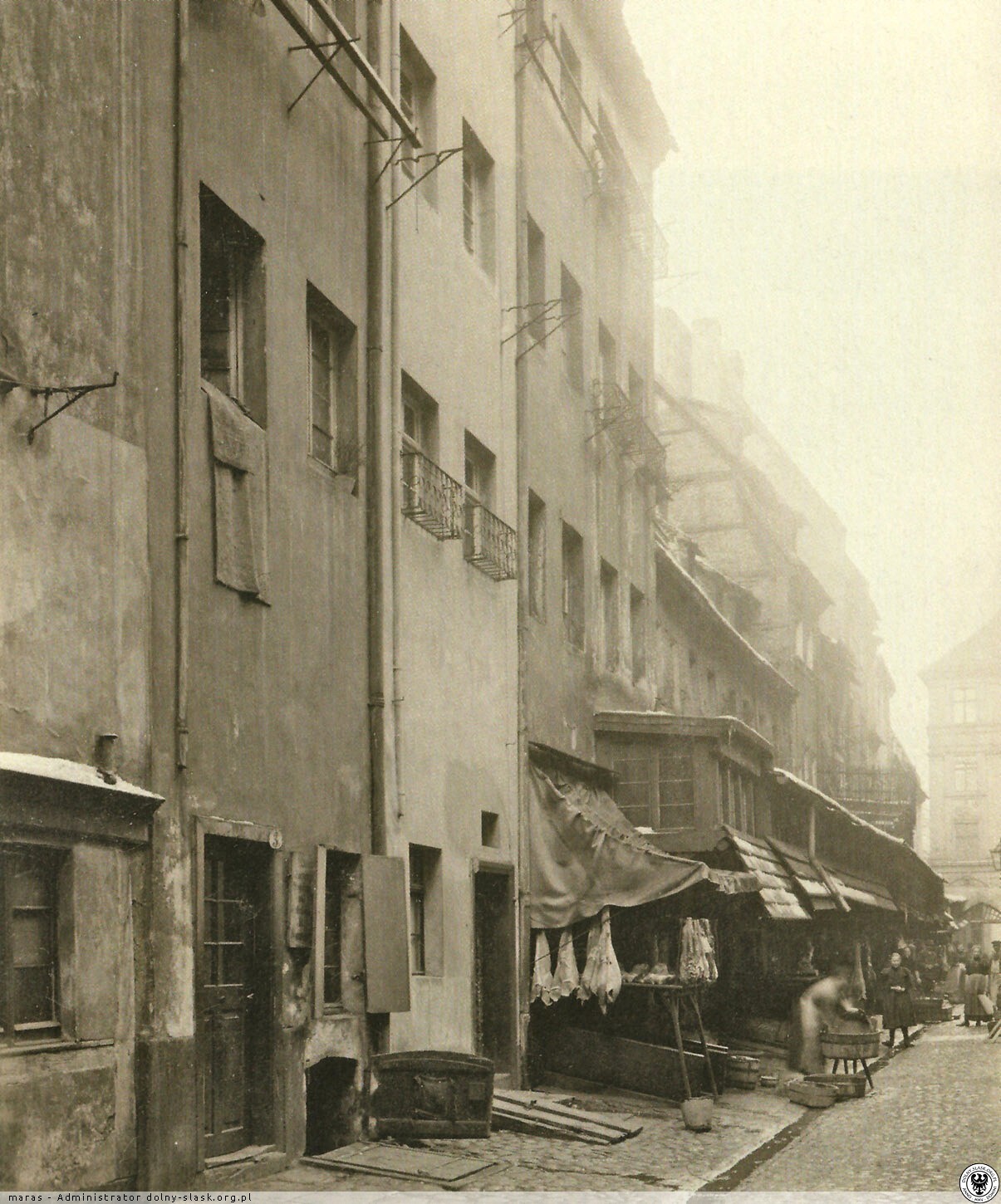
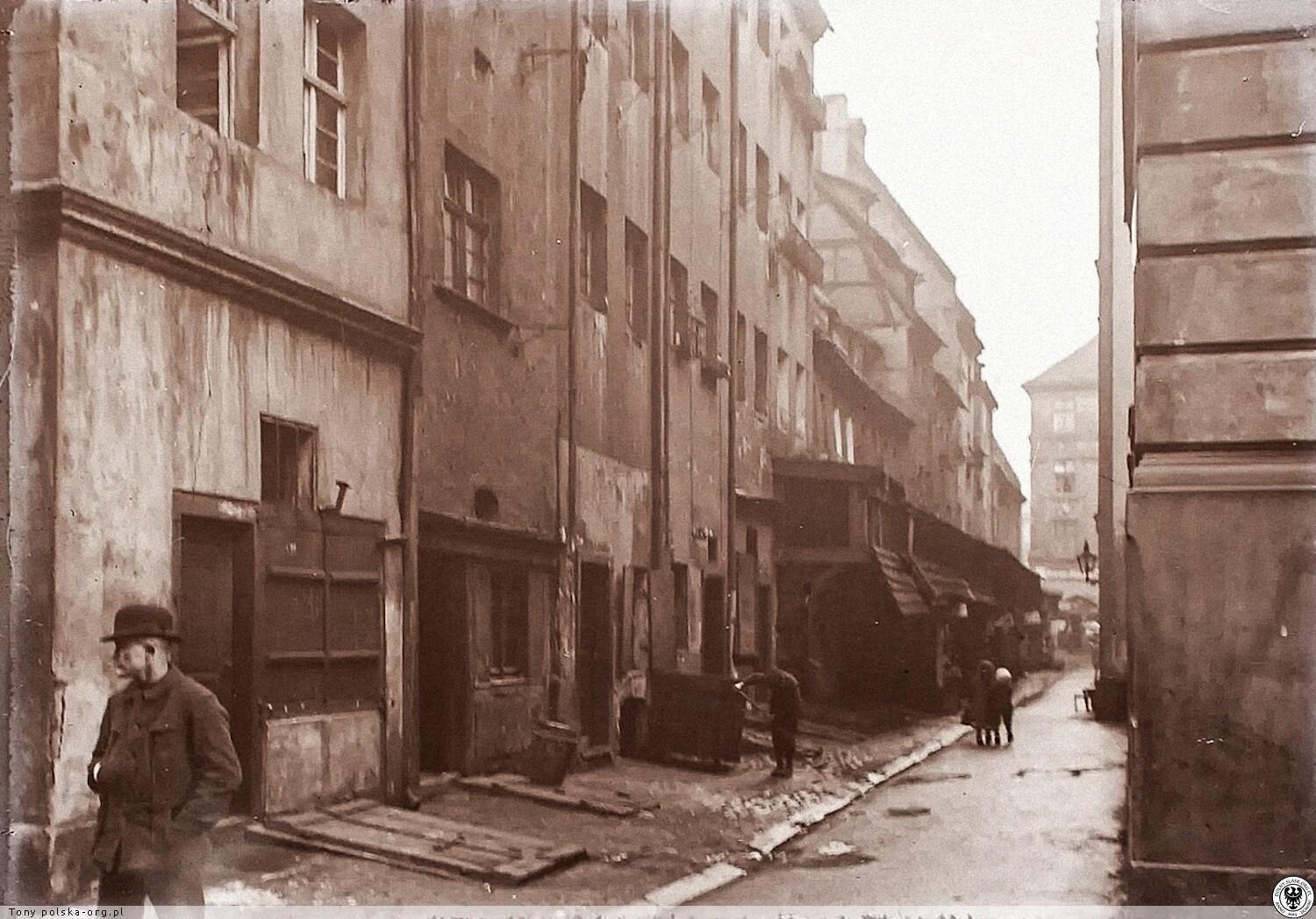
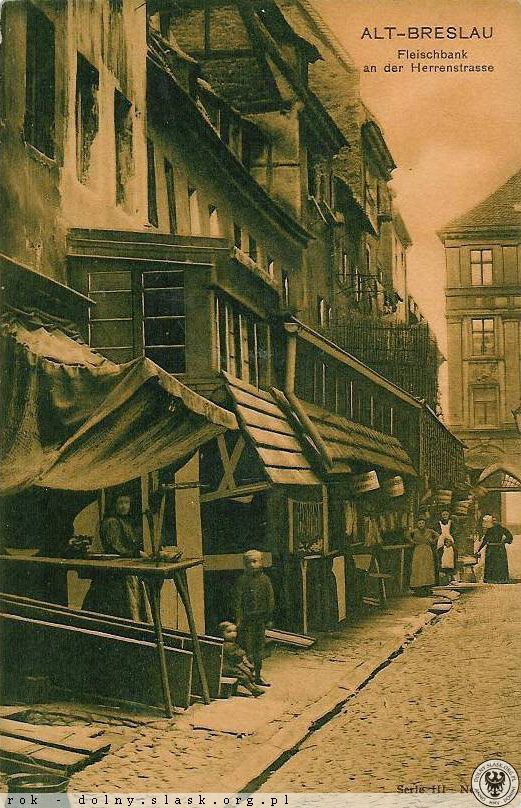
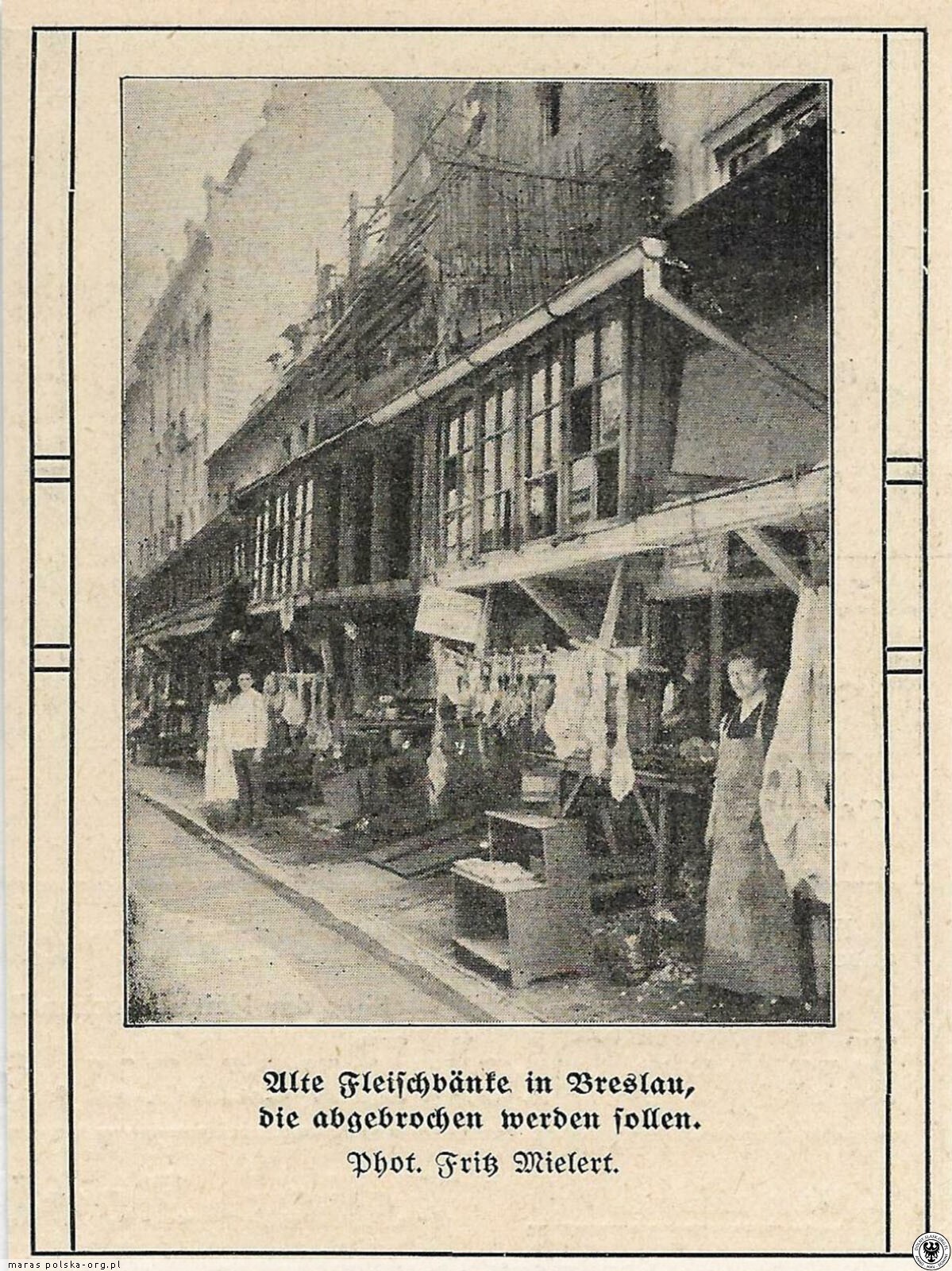
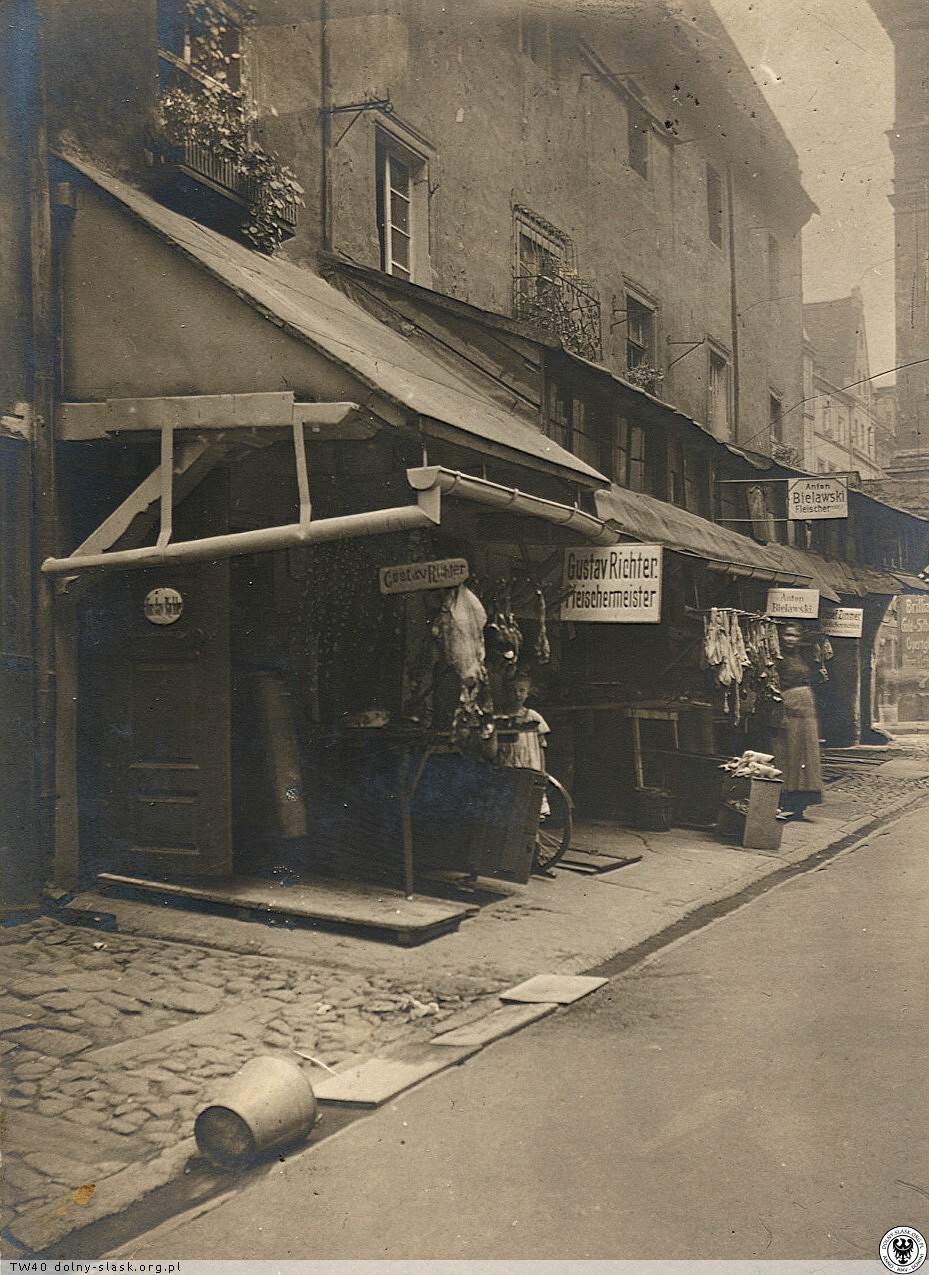
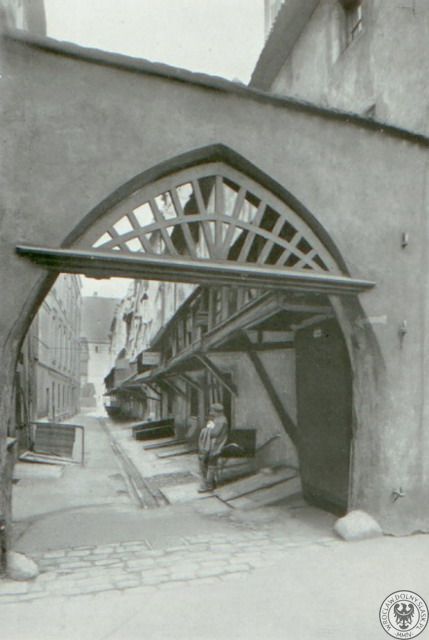
From medieval butcher stalls to art galleries
The history of Jatki dates back to the early years of chartered Wrocław. In 1242, on the initiative of the Silesian duke Bolesław II Rogatka, a complex of butcher stalls was established here. It quickly became the main place for meat trade in the city.
The street originally consisted of two rows of narrow stalls arranged along a passageway. Each stall measured only about three metres in width and roughly ten metres in depth, allowing as many as 48 trading stands to operate within a relatively small area. A stone gutter ran through the centre of the passage, helping maintain cleanliness during the meat trade – traces of it can still be seen in the cobblestones today.
Butchers in Wrocław formed a powerful guild, and for many centuries the meat trade was strictly regulated by the city authorities. In documents from 1375, the site appears under the name “Old Meat Benches” (Stare Ławy Mięsne), confirming its importance in the economy of the medieval city.
At the same time, another group of butcher stalls operated elsewhere in the city – the so-called New Jatki (or Small Jatki) near the Nowy Targ square. The two locations belonged to different butchers’ guilds and for some time competed with each other.
Over the centuries the commercial importance of the street gradually declined. By the late 19th century many of the stalls had been taken over by craft workshops and small shops, and by 1939 only two butcher stalls were still operating here.
After the destruction of World War II, the buildings were rebuilt while preserving the historic layout of the street. In the second half of the 20th century the former butcher stalls gradually began to house art galleries and artists’ studios. Today, Jatki is one of the most distinctive streets of art in the city – a place where centuries-old trade traditions have given way to contemporary artistic creativity
Architecture and hidden details
During World War II, the buildings of the Old Jatki were partially destroyed – only twelve townhouses from the entire complex survived. Reconstruction began in 1951. The work started with building no. 24, next to which stood an arched gateway leading into the street from Odrzańska Street.
During the post-war rebuilding, the ground floors of the townhouses were intended for small shops, while the upper floors were reorganized and combined to create residential apartments. From the side of Malarska Street, shared staircases were added to serve several of the buildings.
The townhouses numbered 1 and 2 are a particularly valuable example of the original architecture. They are the only buildings that have preserved the historic layout of the rooms, wooden ceilings and decorative polychrome paintings featuring acanthus leaf motifs.
In the past, these buildings housed the headquarters of the butchers’ guild. Today they are home to the Wrocław district of the Związek Polskich Artystów Plastyków, and on the ground floor visitors can find an artists’ studio.
As you walk along the street, you may notice large wooden hatches embedded directly into the pavement. These lead to deep, brick-built chambers that once served as cooling rooms. Before electricity, butchers stored ice cut from the Oder River during winter and insulated with sawdust, allowing them to keep meat cool even in summer. The entrances to these former “urban refrigerators” are still visible today.
Running through the center of the street is a shallow channel – a medieval gutter. The cobblestones were intentionally laid with a slope toward the middle, enabling water to wash away waste efficiently. This austere architectural detail recalls the street’s original, craft-based character.
Monument to the Slaughter Animals
At the entrance to the street stands the monument “In Honour of the Slaughter Animals”, one of the most recognizable sculptures in this part of Wrocław. The monument was created on the initiative of Piotr Wieczorek, then president of the Wrocław district of the Związek Polskich Artystów Plastyków, as a symbolic tribute to the historical function of Jatki – a place where butcher stalls operated for centuries.
The sculpture takes the form of a small “herd” of bronze animals. Each figure was designed by a different Wrocław artist: a goose with an egg (Marek Kulik), a goat with characteristic “goat droppings” (Mirosław Grzeszczuk), a pig (Jerzy Bokrzycki), a piglet (Jan Zamorski), a duck (Piotr Butkiewicz), a rooster (Ryszard Gluza) and a rabbit (Stanisław Wysocki).
A plaque set into the pavement bears the inscription:“In Honour of the Slaughter Animals / Consumers.”
The first sculptures – the goose, goat, pig and piglet – were installed in 1997. A duck was added soon afterwards, while the rooster and rabbit appeared in the following years of the 21st century. In June 2017 a calf designed by Jerzy Bokrzycki joined the group (a cow would have been too large for the narrow street).
One figure stands out in particular: the rooster, which is noticeably larger than the other animals. It stands on a pedestal near the entrance to Jatki from Odrzańska Street, as if guarding the entrance to the former street of butchers.
Today the bronze animals are among the most beloved and frequently photographed elements of the street. Visitors often walk among them, touch the polished figures and treat them as a symbolic link between the historic past of Jatki and its present-day artistic character.
Jatki today - a street of art
Today, the former butcher counters have given way to easels, ceramic kilns and jewellers’ benches. The street is home to the Wrocław District of the Związek Polskich Artystów Plastyków (Association of Polish Artists and Designers), which oversees its artistic character.
Jatki now hosts numerous independent galleries and studios presenting painting, printmaking, ceramics, glass art, textile art, sculpture and author’s jewellery. Most works are unique pieces or limited series created on site.
An up-to-date list of galleries and studios currently operating on Jatki can be found on the official website of the Association:
👉 [https://zpap.wroclaw.pl/galerie/]
Thanks to its history and artistic atmosphere, Jatki is sometimes called “the Montmartre of Wrocław” – a small yet vibrant street where centuries of history meet contemporary creativity.
Ćwiąkalska Art Sp. z o.o.
ul. Parkowa 25, 51-616 Wrocław
Numer rejestru KRS: 0000956083
REGON: 521356430
NIP: 8982274245
BDO: 000716445
ul. Parkowa 25, Wrocław
ul. Jatki 1, Wrocław
pn-pt 12:00 - 18:00
INFO
OBSŁUGA KLIENTA
OBSERWUJ
Design & Zdjęcia
© Marta Ćwiąkalska 2021-2026